
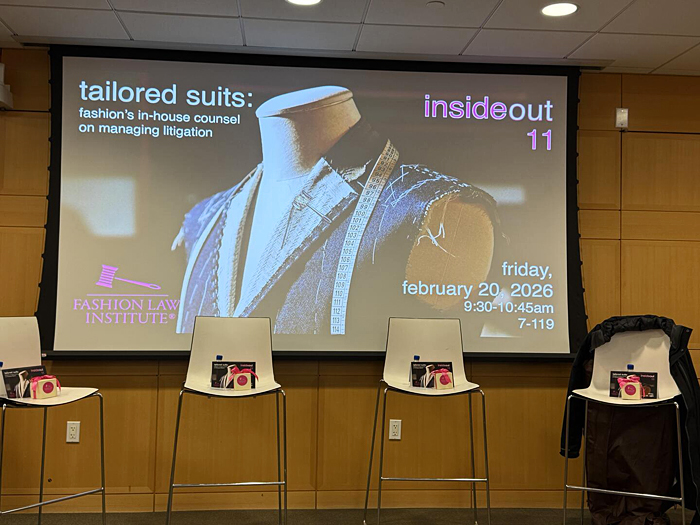
Photo by Laurel Marcus
Last Friday morning, I was privy to a behind-the-curtain look at what in-house counsel at fashion brands take into account when weighing and measuring the construction of a possible suit – a lawsuit that is.
The panel was moderated by Professor Susan Scafidi, Founder and Director of the Fashion Law Institute at Fordham. What happens at the tailor shop stays at the tailor shop, so all panelists spoke off-the-record.
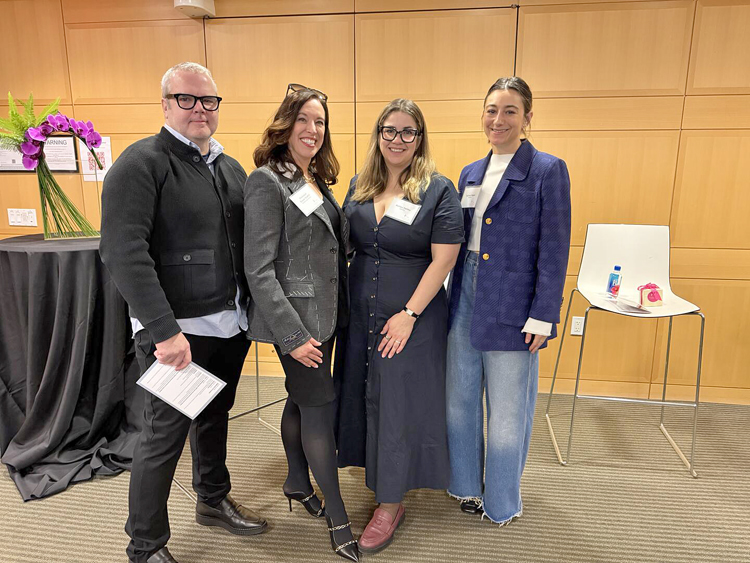
From left to right: John Maltbie, Susan Scafidi, Ashley Valdes, Sydney Kipen, photo by Laurel Marcus
Panelists included Sydney Kipen, Intellectual Property Counsel, Gucci; John Maltbie, Director of Civil Enforcement, Intellectual Property, Louis Vuitton North America; and Ashley Valdes, Assistant General Counsel, Warby Parker.
Fittingly, it was a tale of three jackets. Firstly, Professor Scafidi’s Moschino tailored wool blazer fit the bill to a T with its sewn stitching, tailor’s marks, and contrasting collar. Ms. Kipen wore a navy blazer from Alessandro Michele’s Gucci 2020 Resort collection, emblazoned with the words “My Body My Choice” on the back.
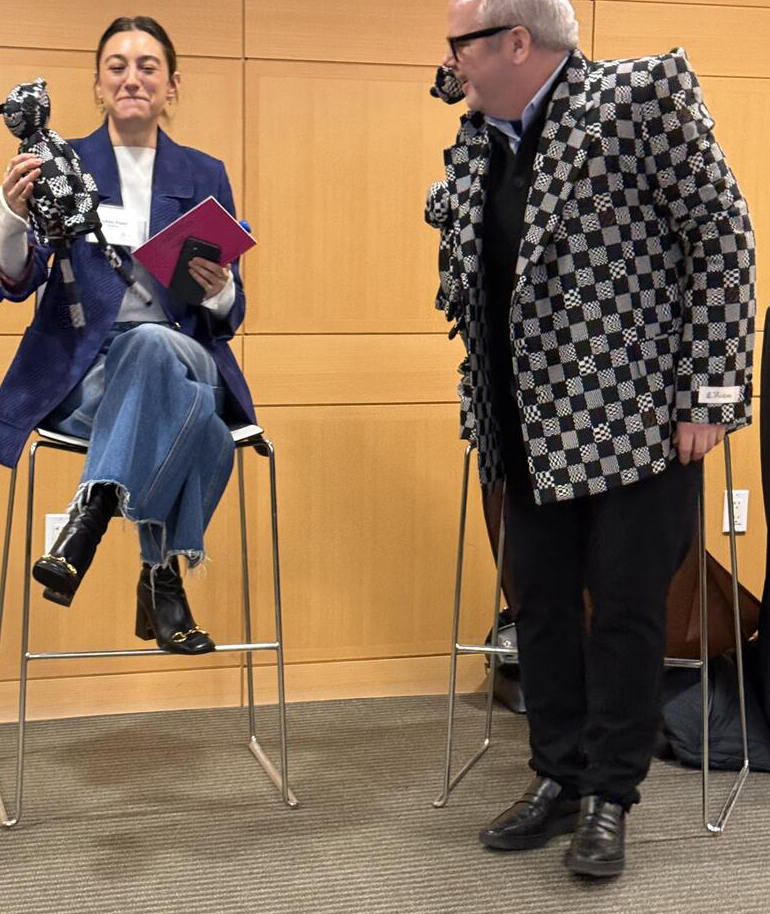
Teddy bears and polka dots – photo by Laurel Marcus
Alluding to Ms. Kipen’s “statement” jacket, Mr. Maltbie removed a black-and-white checkerboard Virgil Abloh for Louis Vuitton jacket with attached coordinating teddy bears from his backpack; however, this rather laughable garment was the impetus for a not-so-funny 2+ year lawsuit.
Although not expressly stated, another designer (Walter Van Beirendonck) believed he owned the rights to display teddy bears on clothing, despite the fact that Abloh was inspired by the designs of former LV creative director Marc Jacobs in 2005.
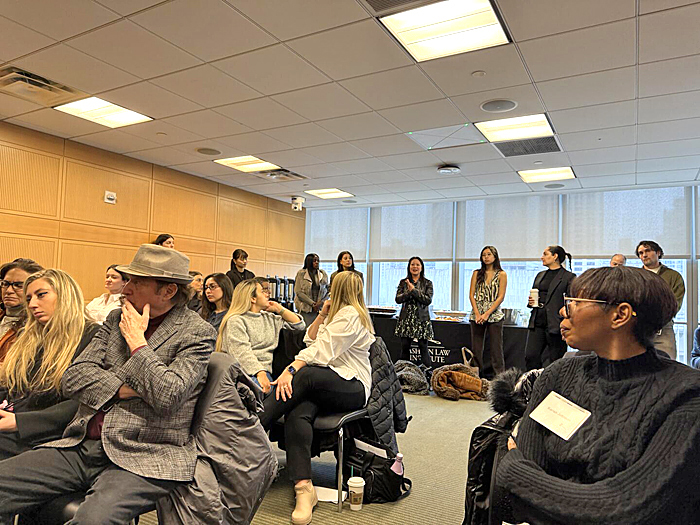
Standing room only – photo by Laurel Marcus
I would think that being in the defensive position would be less common than being the plaintiff – having to enforce protection for a company’s IP and mark and/or to go against bad actors and counterfeits would seem to be the usual daily drama; however, there is “only so much capital to fight.”
Often, a C&D letter (Cease and Desist) will be sufficient to get a seller of counterfeit or otherwise infringing merchandise to stop. There is a risk vs. value in litigation – it is important to know when to back off, and whether it’s possible or worth it to attempt to recover profits or statutory damages. In one such instance, Forever 21 fought back against Gucci, even though Gucci probably never intended to go to court.
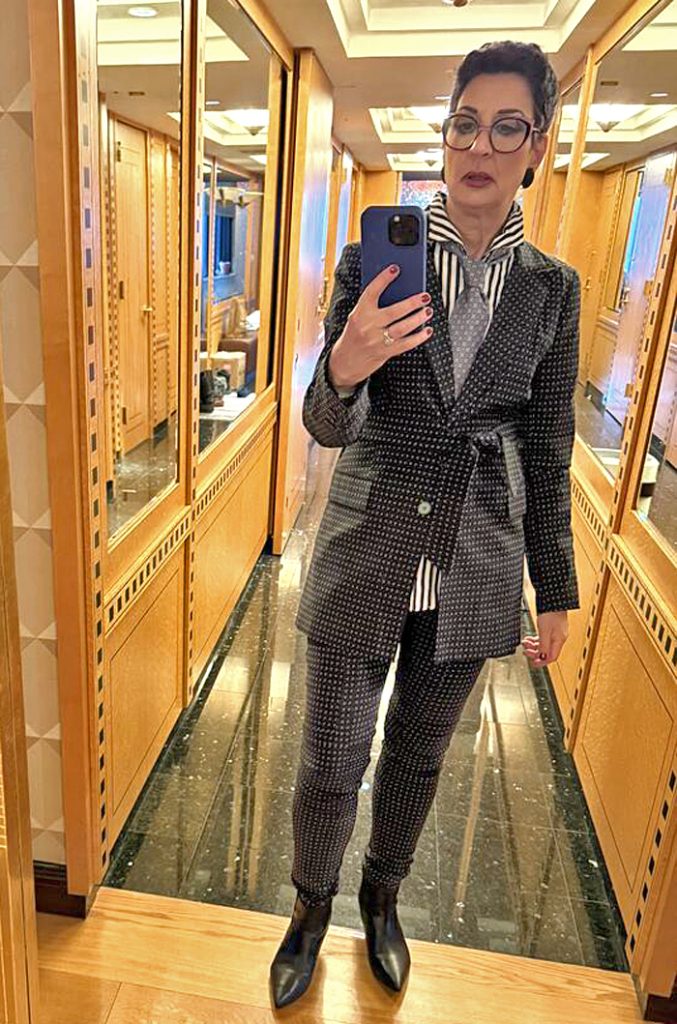
Laurel Marcus of LOOKONLINE “dressed” like a lawyer
Sometimes it’s best to try to keep cases out of the press—for instance, in the case of “upcycling,” reusing or repurposing a designer logo. While public opinion may view this as an environmental issue, what is actually happening is that counterfeit goods are being used, often sourced from rolls of environmentally unfriendly plastic produced in China.
Even if you use real goods, it is still infringement if you try to turn the material into something else, such as a bracelet or a hat. It is considered trying to capitalize on the trademark or logo and profit from it. What of Dapper Dan or Gucci Ghost, you might ask? They built a relationship with the brand during the lawsuit. It has to get through the creative side – a “what if we explore something else,” if you will.
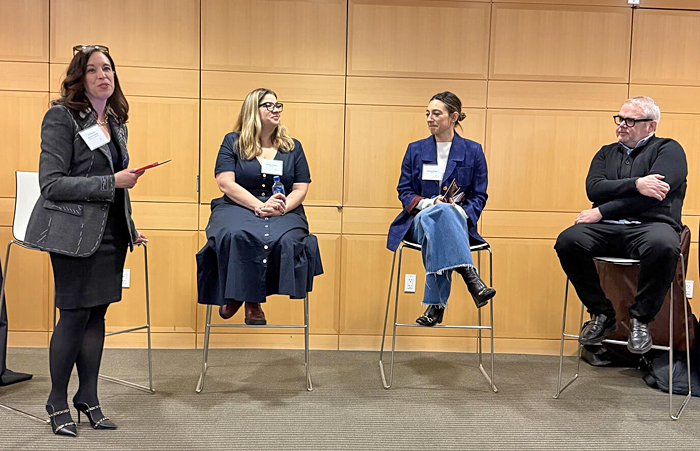
Susan Scafidi, Ashley Valdes, Sydney Kipen, John Maltbie – photo by Laurel Marcus
The art world is a very litigious place – when Yayoi Kusama collaborated with LVMH with her circle dots (which she has been drawing since she was 10 years old) they found that other artists lay claim to the use of dots. One artist’s counsel claimed she had stolen his artistic idea when, in fact, the suing artist would paint over a photo of a famous person, such as Kate Moss or Marilyn Monroe, with dots.
He didn’t own the copyright to those photos, and other artists, such as Damien Hirst, also known for dots, had also been accused of copying from him.
Interestingly, legal services are the rare instance in which fees are negotiated after the work is done. Try doing that to a surgeon after an operation. In-house counsel often reminds their employers that this is not a profit center for the company – it will always take the L.
Don’t even mention AI to these brands – although billed as “increasing efficiency and creating new things,” what does it even mean to use the platform for litigation that you don’t own and can’t license?
As the hour and 15-minute breakfast meeting drew to a close, Professor Scafidi remarked that she had just gotten good news for fashion as the Supreme Court struck down the tariffs – but apparently not for long – by lunchtime they were back up.
LATEST COMMENTS

test comment
Marilyn, You look absolutely fabulous! And this Elsa Schiaparelli bag !!!! We have met a few times at different events.…


FROM: American fashion designer Ralph Rucci: A major home run! How extraordinary this young lady is, and along with her…