
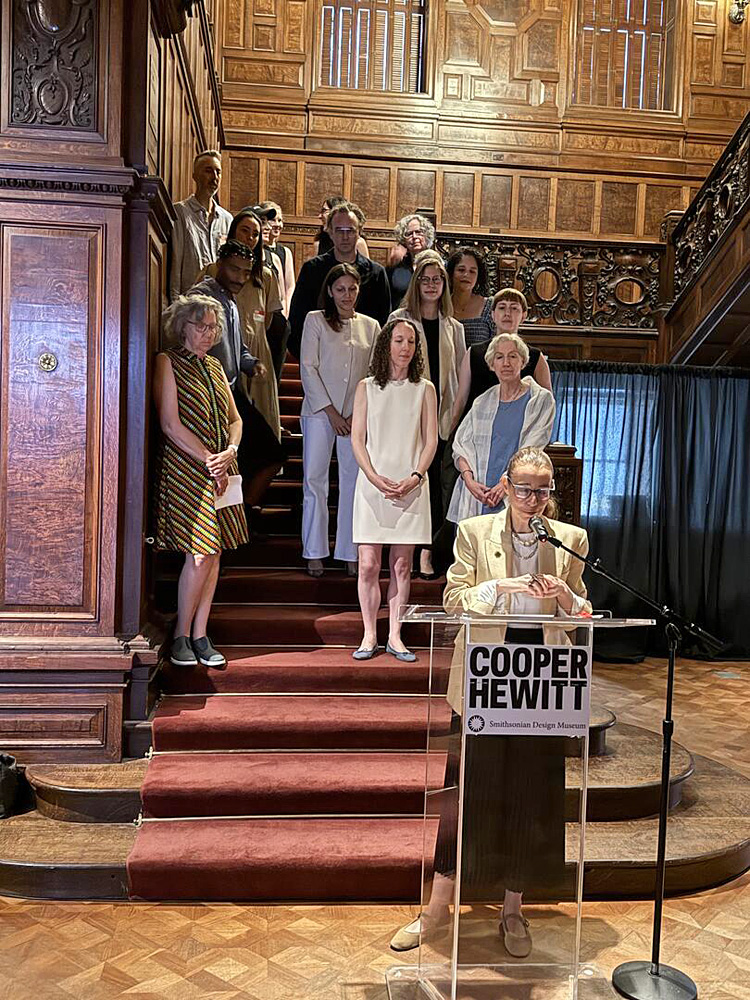
Maria Nicanor & curators, photo by Laurel Marcus
How many curators does it take to assemble a far-reaching, six-year-in-the-making, long-term exhibit at Cooper Hewitt, Smithsonian Design Museum? Apparently, it takes a village.
I attended a press preview on Thursday morning for “Design Across Time: Exploring the Smithsonian’s Design Collection,” which opened Friday, 6/26. Within the first-floor space of the museum’s Carnegie Mansion, you will find items from the storage vaults of the permanent collection, along with some new acquisitions, all of which went through an extensive editing process.
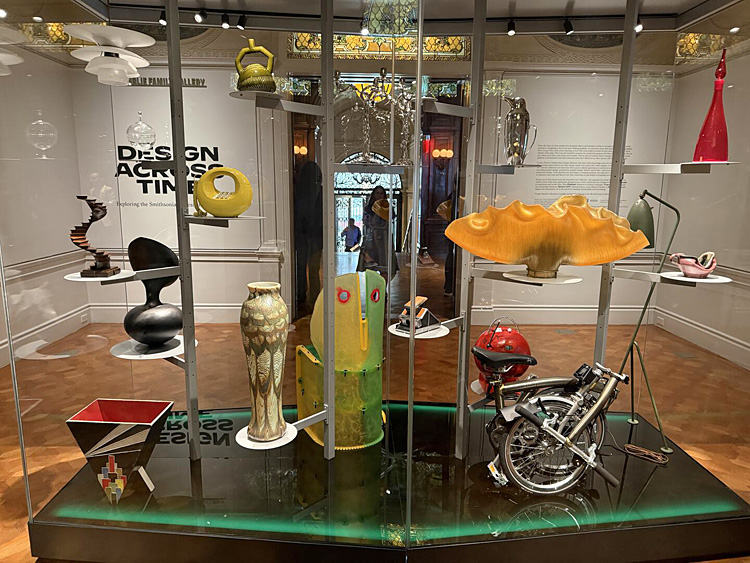
Various objects of design, photo by Laurel Marcus
Out of more than 215,000 items, these 125 made the cut for now, and items will be rotated over the next two years. The objects span multiple design disciplines, including product and graphic design, fashion, textiles, digital design, wallcoverings, and architecture.
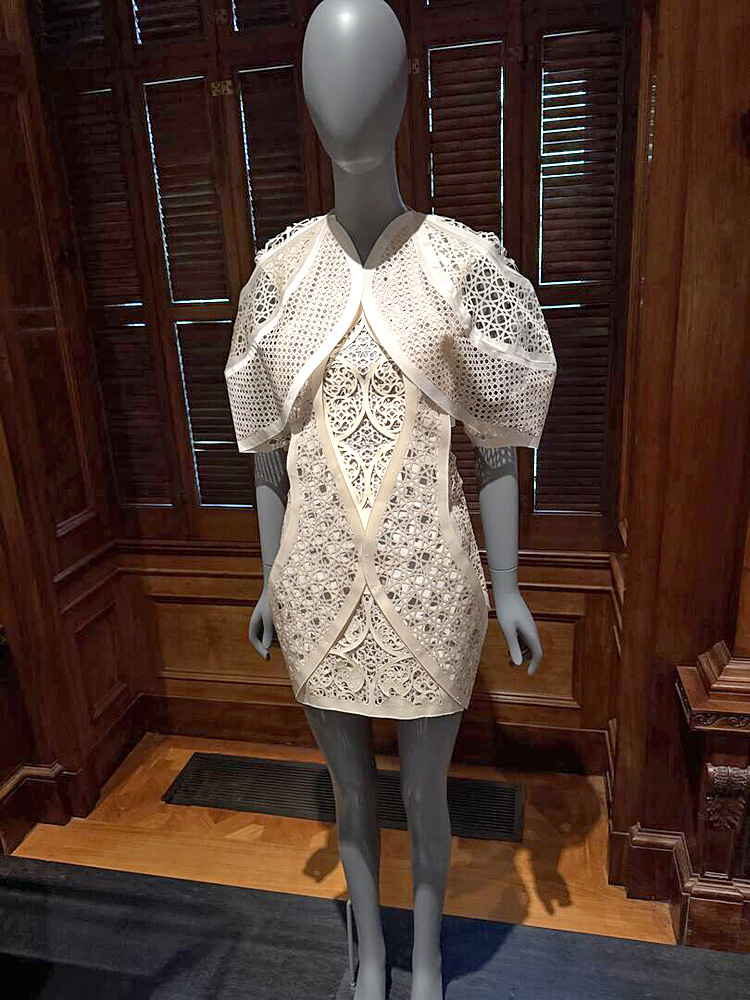
Three AS Four dress, photo by Laurel Marcus
Objects are loosely categorized into six themes: Repeat, Transform, Simplify, Show Off, Play, and Tweak. “The exhibition is rooted in this idea that design is everywhere, that it is not neutral and that it serves a civic purpose,” said Maria Nicanor, director of the museum. “Through its narrative, the show also reveals that from small objects to larger systems, everyone is an expert user and an active participant in the built environment.”
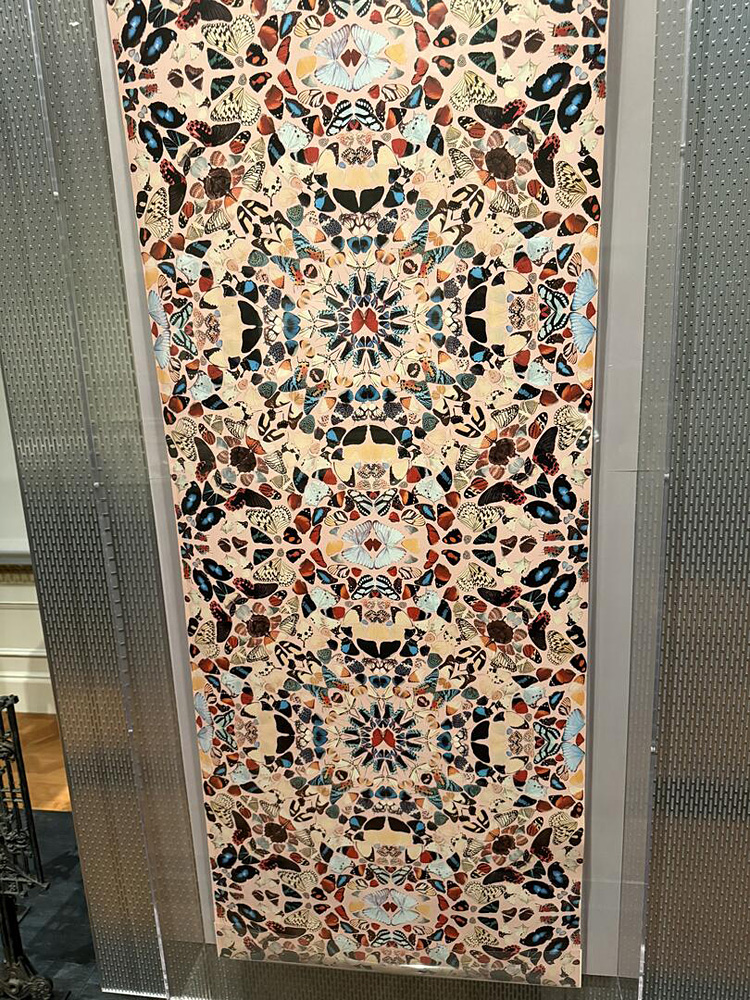
Damien Hirst butterflies, photo by Laurel Marcus
She referred to the vast and varied collection from 30 centuries and six continents, which is mind-blowing. The juxtaposition of what’s current and perhaps familiar with what’s ancient and more exotic is part of the gestalt.
I mostly focused on the textile and fashion items throughout. In the Repeat category, the repetitious nature of pattern design, including block, screen, and roller printing, was emphasized. A Damien Hirst textile of butterflies, giving a Kaleidoscopic effect, evoked the 2013 Alexander McQueen scarf collaboration.
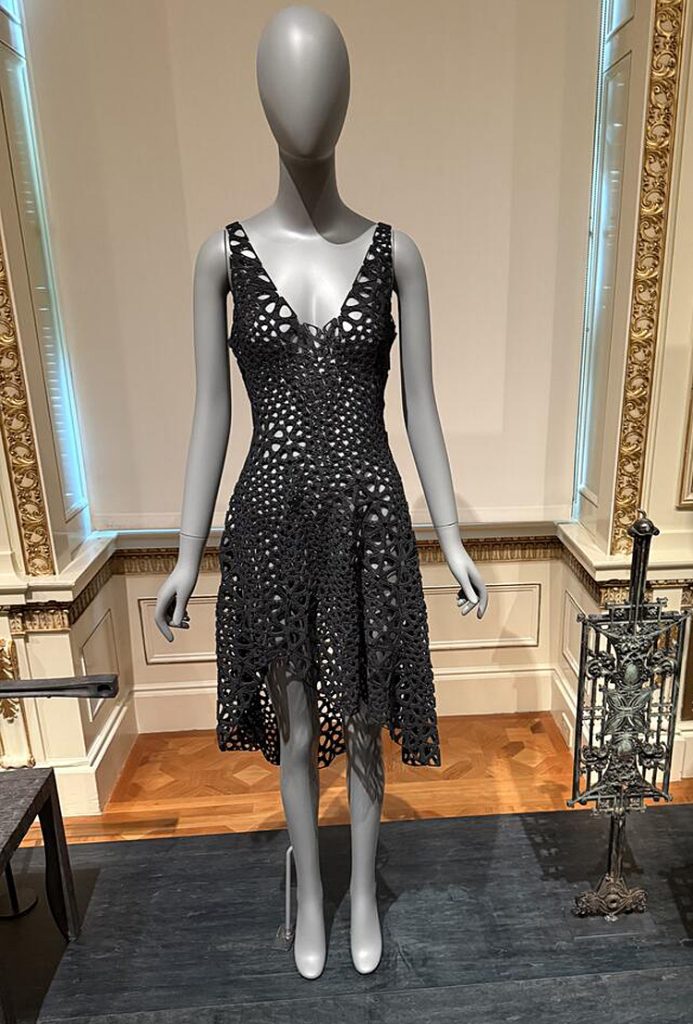
Kinematrics dress, photo by Laurel Marcus
The Kinematics Dress (2015) uses 3D-printed nylon, with each component identical in shape but varying in size, allowing for a customized fit. There is also a Style Stiletto Textile (2011) from the Netherlands, reminiscent of Andy Warhol’s designs.
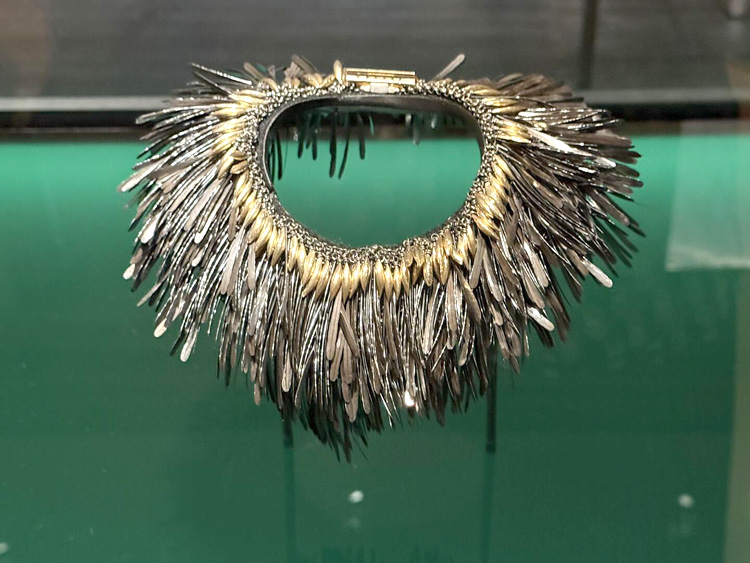
Necklace of hammered nails, photo by Laurel Marcus
The Transform section featured a “feather” necklace, actually made from hammered steel nails with touches of gold, silver, and mother-of-pearl (1983), and a Vitamin Store necklace made from pill capsules, ca 1990. There is also a 1966 striped Paper Dress from Mars Manufacturing Company
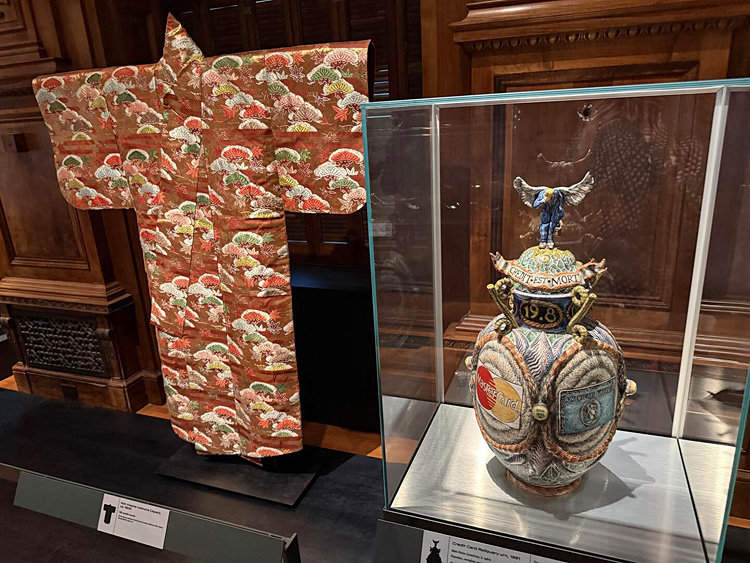
Showoff category, photo by Laurel Marcus
In the Show-Off section are some beautiful examples of handwork, including a Man’s lace collar (Italy) 1650-75 (the second oldest item in the exhibition) as well as a more contemporary piece, the Temple Dress from ThreeASFOUR (2013) of laser-cut bonded silk organza. A Very Large Nazuna Vase, 2016, of molded, carved, and hand-built porcelain echoes the intricate lace-like theme.
The Noh theater costume (Japan ca. 1800) of silk metallic brocade is also featured here, as well as an Artist’s Book, Hands of Josephus V., 2010, a hand-cut and bound-altered book with beaded cords on a wire hand form. The Coricancha necklace (1995) is made of Rhodochrosite, amethyst, nacre, pearls, and gilded silver.
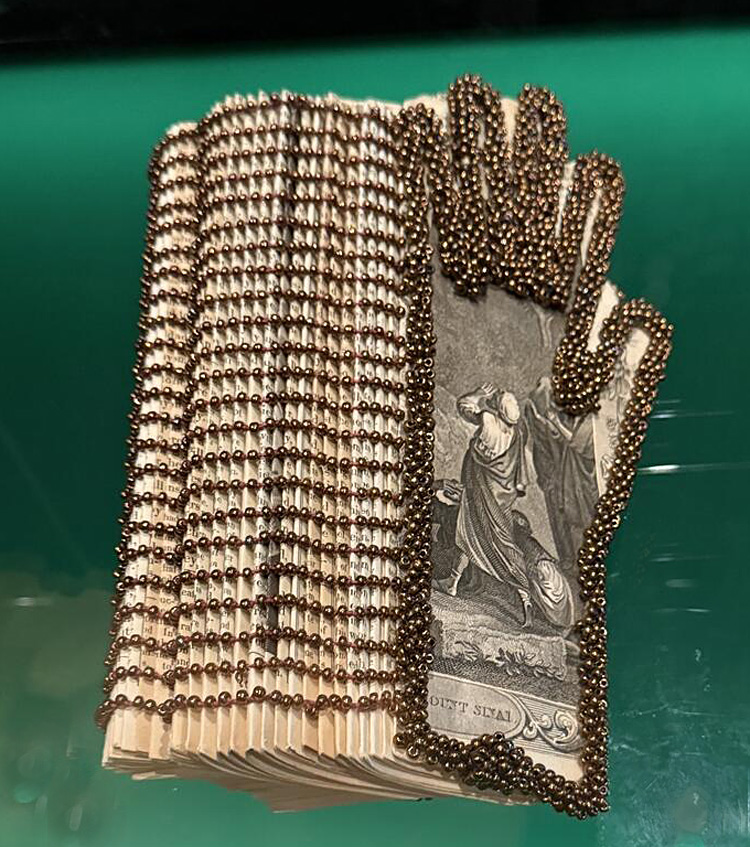
Artist’s Book, Hands of Josephus V., 2010, photo by Laurel Marcus
The Simplify section – where things are stripped down to their essence — did not feature any real fashion moments but did include a Malcolm X film poster (1992), chairs without legs as in Stacking Side Chair (1972), Switzerland, and the Flex-Foot prosthetic running foot blade (2013), Iceland, reminding me of that horrible sprinter and convicted murderer Oscar Pistorius.
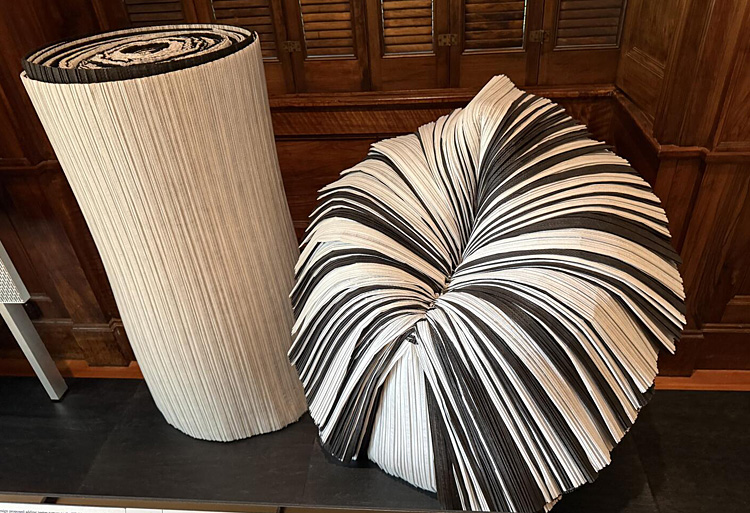
Issey Miyake Pleats Please chair made from waste fabric, photo by Laurel Marcus
The Tweak section displayed items that had undergone small, iterative changes of modeling, prototyping, but no fashion per se, while the Play section (the designer wants the end user to play) had perhaps one of my favorite items: the Cabbage Chair, 2008 nendo (Tokyo, Japan) – made of resin-coated wastepaper used in the production of PLEATS PLEASE, Issey Miyake garments. The chair arrives in a wrapped bundle and will supposedly form to the user’s posterior with use.
Back to the beginning — as a small group of us waited in front of the podium for the press preview talk to begin (many key figures were apparently caught in traffic), suddenly there was movement afoot. A large group of those who had been milling around the entrance took to the stairs behind the podium, and I, in my early-morning stupor, followed suit.
I quickly realized that these were the curators lined up and that I had just followed what seemed like the herd. As I resumed my intended spot in front of the podium, I heard one of the speakers remark, “Well, I do say this exhibit is for everyone,” to audience laughter. Cringe moment alert!
LATEST COMMENTS:

test comment


FROM: American fashion designer Ralph Rucci: A major home run! How extraordinary this young lady is, and along with her…