
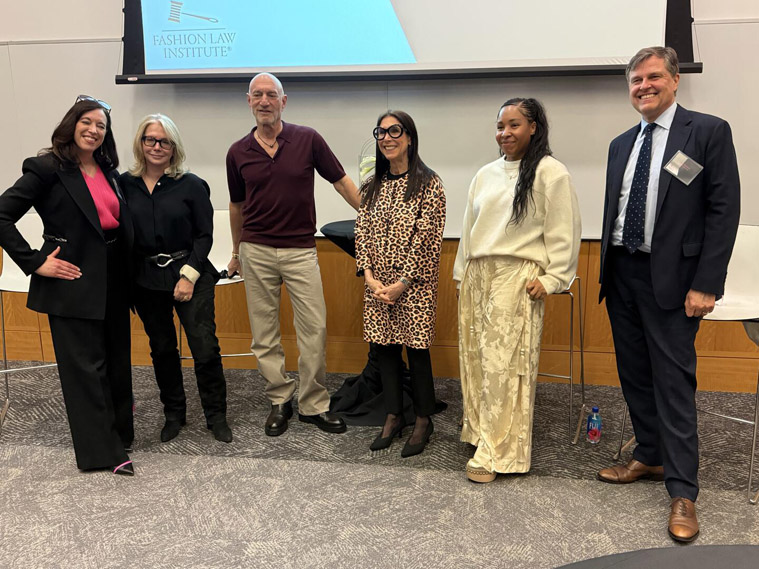
Prof. Susan Scafidi, Pamela Bradford, Gary Wassner, Doreen Small, Kai Reevey, Jeff Trexler – photo: Laurel Marcus
When we think of a fashion show, we generally focus on the creative/design part, not the myriad legal agreements that must be in place for the show to happen. Everyone must be under contract, from fashion models to hair stylists and makeup artists, influencers, celebrities in the FROW, and other independent contractors, as well as the music, venue, and security concerns; all have to be approved.
I learned more about this on Thursday night during a spectacular deluge at Fashion Law Institute’s “Law of the Fashion Show II.” The weather did not dampen the electricity in the air, which is always evident in these events. Interestingly, part one of this series occurred in 2012 – predating my involvement, so I could only guess how much everything has changed in a decade and a half.
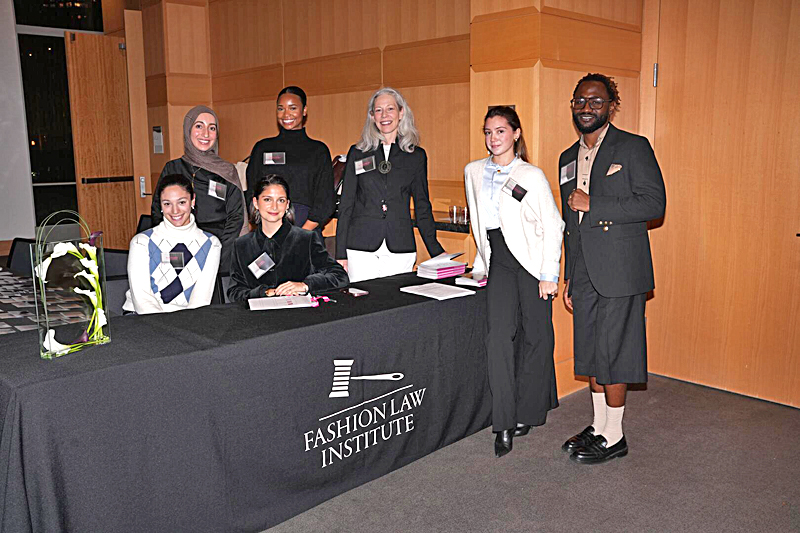
Student volunteers
Panelists were Pamela Bradford, former EVP and General Counsel, Calvin Klein, Inc.; Gary Wassner, CEO, Hilldun Corporation; Doreen Small, Partner, David Shapiro Lewit and Grabel LLP; Kai Reevey, VP & Counsel, WME; and Jeff Trexler, Director, Comic Book Legal Defense Fund Inc. Professor Susan Scafidi, Founder and Director, Fashion Law Institute at Fordham, served as moderator. Panelists voiced their own opinions, not representing their companies, and quotes will not be attributed.
The general mood was that New York Fashion Week a decade ago was riding high and has now lost a bit of its luster (don’t we know it) due to several different elements (more on that later). First up: What is the purpose of a fashion show at NYFW? One panelist stated it is “to generate sales – to provide the bells and whistles that cause consumers to see and want to buy the brand. It’s a live advertising campaign with a business paying a fortune to show who they are that season.”
“What hasn’t changed is how fashion shows work – no matter how you try to prepare, it’s ultimately an organic thing.” This includes having to clear new songs (for copyright infringement) often just hours before the show. Similarly, changes to printed materials such as the program are subject to scrutiny and must be “cleared” before any litigious repercussions.
“We want to use this butterfly,” the designer might say. Who owns this butterfly? Do you have the rights? Reverse image searches ensue to make sure it’s not a famous butterfly or too similar to one. Can you make changes to mitigate risks? (In other words, butterflies might not always be free ha. “Until a fashion show goes live, you are dealing with change,” the panelist explained.
What has also changed, of course, is the influencer aspect. “It used to be about the brand – everything was more personal rather than disseminated through social media.
One panelist remarked that buyers used to sit in the front row, but influencers and celebrities have largely replaced them. In fact, buyers have stopped attending many shows because it is expensive and time-consuming to travel all over Manhattan and even Brooklyn to various shows, and it is very difficult without a central venue such as Lincoln Center. The demise of Eleanor Lambert’s Fashion Calendar and the passing of Ruth Finley (the woman who put NYFW on the map) have had an impact, as shows now conflict with each other, making “New York less viable for fashion shows.”
There is no one to take ownership of NYFW (the CFDA puts out a calendar, but it is not the only one) and no central body, which used to be IMG, according to a panelist. “We need a mayor’s office that cares about this as Bloomberg did. He took suggestions from the fashion industry and understood that it is a huge boon to the city. NYFW used to bring in 800 million dollars for fashion week – now it’s about $600 million.”
As for models, a panelist remarked that there have been changes in race, gender, size/weight, and age. She felt there is far more diversity in race, while age has shifted toward both ends of the spectrum. No children dressed as adults are walking the runway (the Fashion Worker’s Act made sure of that), and some older people are now included as well. As for weight, with GLP-1s so rampant, a few designers still feature plus-size models, including Christian Siriano and models such as Ashley Graham, Paloma Elsesser, and Precious Lee.
What about the A.I. likenesses of actual models in advertising or eventually on runways? A.I. requires a model’s consent, and it must be clearly stated as A.I. Can a model be altered and put in different clothing? Can you change an image into a video? What happens when her “digital twin” is made from a scan of her body, and who owns that image? One panelist remarked that the model could sleep in bed while her DT (Digital Twin) works—“watch and hold this space.”
“New York Fashion Week has never been more volatile than this recent season…” read the first line of the accompanying seminar reading materials. Yes, the elephant in the room regarding the PETA protest at the Cos show was poked at a few times and then quickly retracted. Like a kid sticking a finger in an electric socket, the topic is too hot. Unfortunately, this incident became the season’s defining moment, and like NYFW itself, no one wants to take ownership or speak out on the failures that led to it.
COMMENTS:


FROM: American fashion designer Ralph Rucci: A major home run! How extraordinary this young lady is, and along with her…