

Patricia Mears, photo by Marilyn Kirschner
On Wednesday, January 15th, the Fashion Institute of Technology (FIT) formally welcomed Jason. S. Schupbach as the new President, succeeding Dr. Joyce F. Brown. As we enter a new year, this is not the only high-profile “Changing of the Guard” at the well-respected institute.
“As deputy director and curator, Patricia Mears has contributed so much to The Museum at FIT that it is hard to know where to start. Her many brilliant exhibitions, her mentorship to members of the museum staff, her financial and organizational skills – all of these have contributed so much to making The Museum at FIT the great fashion museum that it is today.”- Dr. Valerie Steele, Director, The Museum at FIT
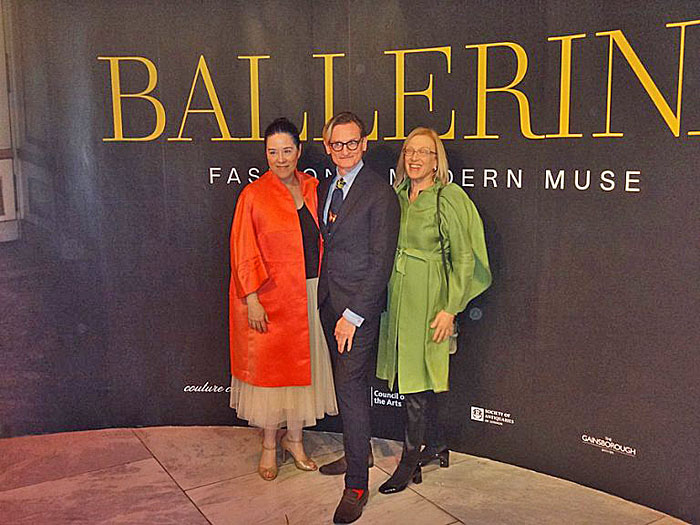
Patricia Mears, Hamish Bowles, Valerie Steele, Photo by Laurel Marcus
“I feel fulfilled and grateful, but the time is right for me to step away,” says Mears, who is grateful for the women who came before, “The Greats” as she calls them: Mme. Grès, Vionnet et Jean Patou. But so much has changed. In the 80’s, when Patricia came into the industry, fashion was highly charged and very exciting. Extremely innovative designers (particularly the Japanese) possessed amazingly artisanal qualities. The shows in Paris were a cultural phenomenon.
Fashion has become more sophisticated and intellectual, and we are looking at things from a broader perspective. This is a plus, but like everything else, there is a downside to everything, notably, the fast pace. “The time needed to craft not only garments but also for creative directors to find their footing is not given to them,” opines Patricia.
Equally challenging is the rise of social media. While there are many advantages, navigating this medium has really upended how every creator produces, says Mears, who looks forward to spending more time with her husband on their upstate farm, where they raise chickens for eggs, have a small vegetable garden, and grow apples for cider. I wonder what she’s going to do with all her museum-quality clothes, lol!
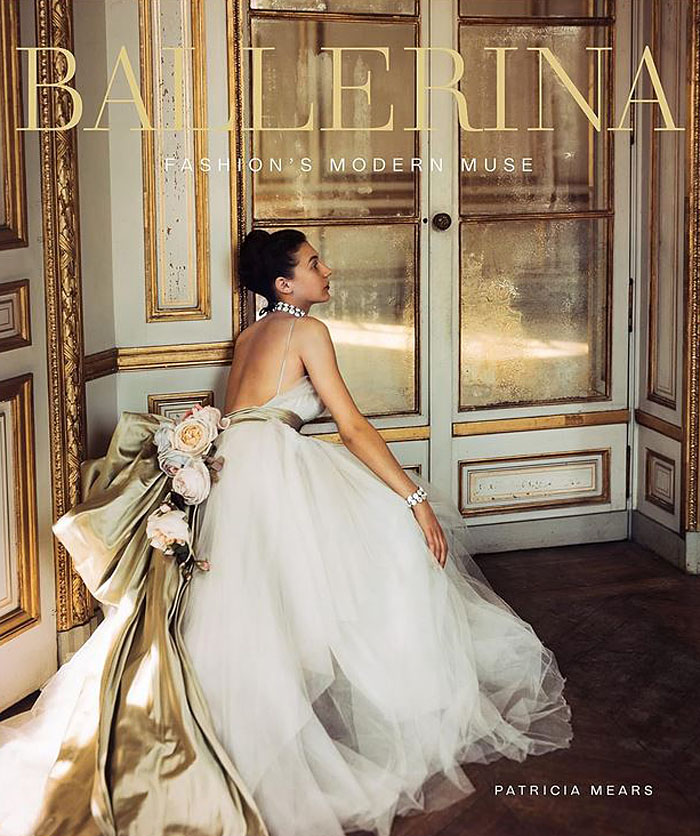
Ballerina Fashion’s Modern Muse book by Patricia Mears, amazon.com
During her tenure, Patricia has curated or co-curated at least 11 exhibitions and written the accompanying books, beginning with Mme. Grès: Sphinx of Fashion, 2008. Patricia’s last exhibition was Designing Women: Fashion Creators and their Interiors (2023). An attending book published by Bloomsbury is scheduled for release later this year.
“The best part of being a curator was working with objects. I was fascinated with beautifully crafted garments even before I entered the field, and this feeling has never diminished. Moreover, curators get to experience fashion without the challenges that face others in this industry, like journalists and retailers.”- Patricia Mears
Mears was always interested in how things were made, and she was especially captivated by the technical aspects of Mme. Grès’ work. Madame Grès was a master sculptor, a true artist who elevated dressmaking to an art form and the subject of Patricia’s master’s thesis, which she wrote about back in the early 1990s. “It was wonderfully fortuitous that MFIT gave me the chance to present a retrospective of her work, Madame Grès: Sphinx of Fashion, in 2008”.
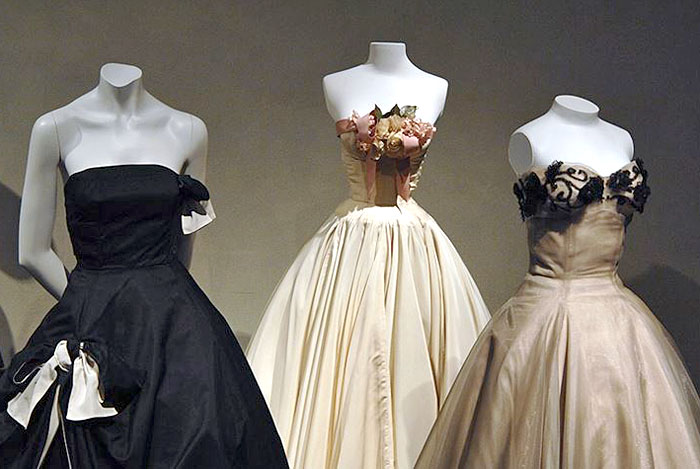
Mme Gres “The Sphinx of Fashion” – photo courtesy Museum at FIT
Despite the high regard in which Madame Grès is held, the details of her innovations and the evolution of her distinctive style remain relatively obscure. This exhibition was the first to identify three primary styles as distinct terms in the Grès lexicon: the classically-inspired, “Grecian” style of her pleated gowns; the “ethnic” inspirations behind her simple, geometric designs; and the billowing, three-dimensional quality of her “sculptural” coats and gowns.
Mears observes that each exhibition came about in different ways. For example, with “IMPACT: 50 Years of the CFDA (2012), co-curated with Fred Dennis, it was that organization’s president, Diane von Furstenberg, who had the idea. It was the CFDA’s 50th anniversary, and Diane wanted a special exhibition and book to commemorate its founding.
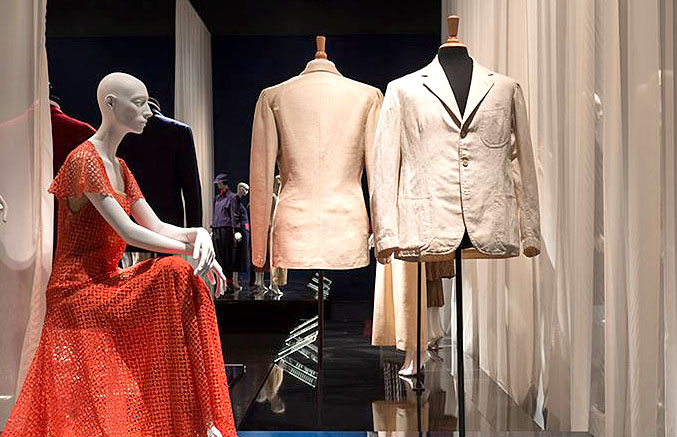
Elegance in an Age of Crisis: Fashions of the 1930’s, photo courtesy Museum at FIT
Perhaps one of Patricia’s most personal exhibitions is “Elegance in an Age of Crisis: Fashions of the 1930s” (2014), which presented both men’s and women’s fashions. The 30’s, defined by a streamlined art modern aesthetic, are Patricia’s favorite period in fashion: a time of great stylistic achievement and technical innovation, in stark contrast to the preceding Edwardian era.
The show featured 80 ensembles and 30 accessories that celebrated how—despite limitations brought on by the financial crisis—the era’s leading dressmakers and men’s clothiers reinvented shapeless styles of the 1920’s with more elegant, featherweight textiles. “We still see the influences every time a man dons a sleek, double-breasted jacket, or a woman wears a classically inspired goddess gown. Clearly, the 1930s still resonate with designers today.”
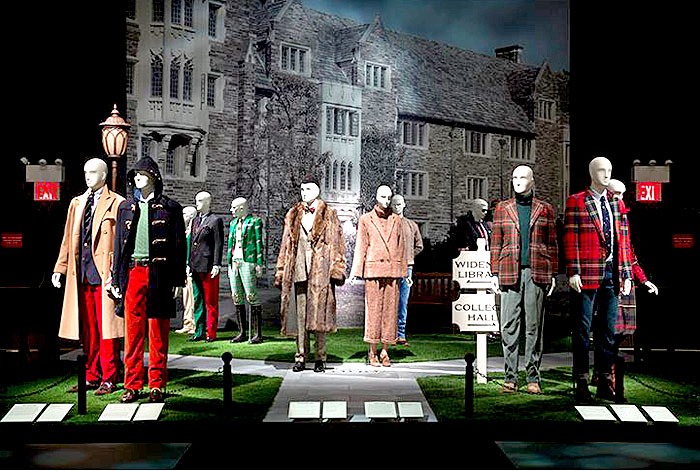
Ivy Style, photo courtesy Museum at FIT
One of Patricia’s more unique shows is Ivy Style. Mears spent her entire career focusing on modern, high-style women’s fashion. With Ivy Style, she was a neophyte entering the world of menswear. She was drawn to the look for its enduring, historic yet modern quality, global yet quintessentially WASP American, as defined by designers like Thom Browne and especially Ralph Lauren. Patricia singles out Ralph as a brilliant merchandiser who works hard, stays in the business, and creates an entire universe of his own without being a trained designer.
A few years ago, when Patricia asked Marc Jacobs to name his favorite designer, he said, without hesitation, Ralph Lauren. This led to another thought. What would fashion be without immigrants, citing Italian tailors and Jewish merchandisers!
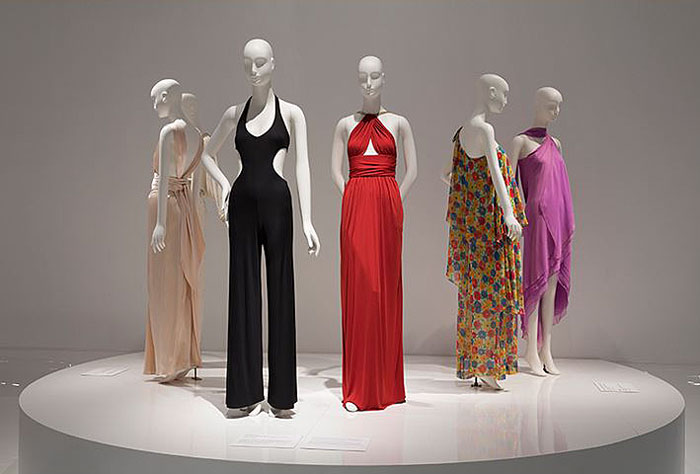
YSL + Halston, Fashioning the ’70s , photo courtesy Museum at FIT
What is Patricia’s most surprising exhibition? “Yves Saint Laurent + Halston: Fashioning the ’70s” (2015). When Mears, who usually begins with a preconceived notion about a designer, organized the Yves Saint Laurent and Halston exhibition, she assumed the former produced opulent, brilliantly colored fashions while the latter created streamlined, neutral garments.
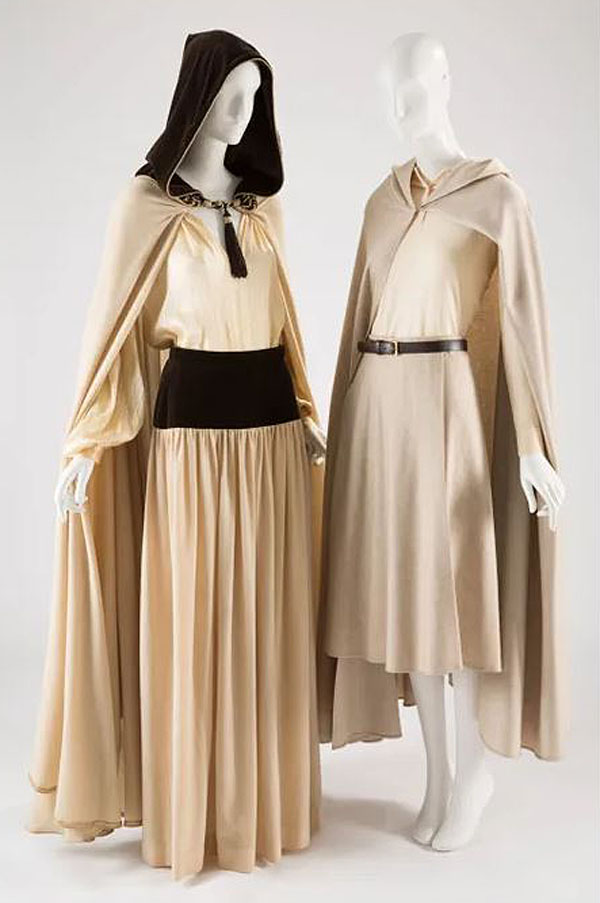
YSL + Halson, Left, YSL Rive Gauche, 1976, Right, Halston 1970-71 – photo courtesy Museum at FIT
While that was partially true, both were far more expansive in their output. So much so that she paired similar-looking garments – columnar gowns, beige capes, or printed chiffon dresses (all from our own collection) side by side and asked the viewers to pick who designed which. They did not always get it right.
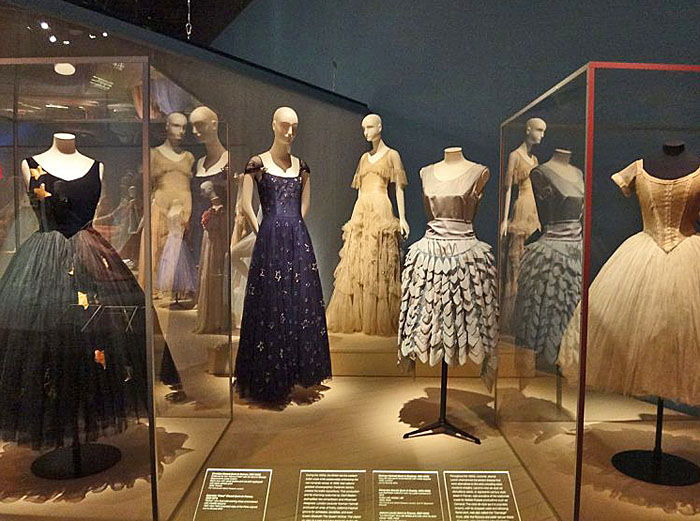
Ballerina Fashion’s Modern Muse, – photo by Laurel Marcus
Mears was stunned that there had never been a large-scale exhibition or comprehensive publication on the subject of classical ballet’s influence on fashion, Ballerina: Fashion’s Modern Muse (2020). Her goal with this exhibition was not only to present the idea through costumes and fashion, but also to ask how and why this phenomenon occurred and how the British and Americans led the way in bringing ballet to the forefront of Western culture.
“Patricia Mears is an intellectual, yet Highly Emotional Magician. I know this not only because I have seen it through her dazzling exhibitions and poetic, scholarly writings, but also because one of the greatest experiences of my life was having her and Dr. Valerie Steele write a psychiatric thesis on me and my work, called “The Art of Weightlessness.” – Ralph Rucci
One of the most memorable exhibitions Mears co-curated, along with Dr. Valerie Steele (and Clare Sauro), is Ralph Rucci: The Art of Weightlessness (2005). Here, Mears closely examines the garments Rucci designs, reveals what makes them so special, and considers influences on his work.
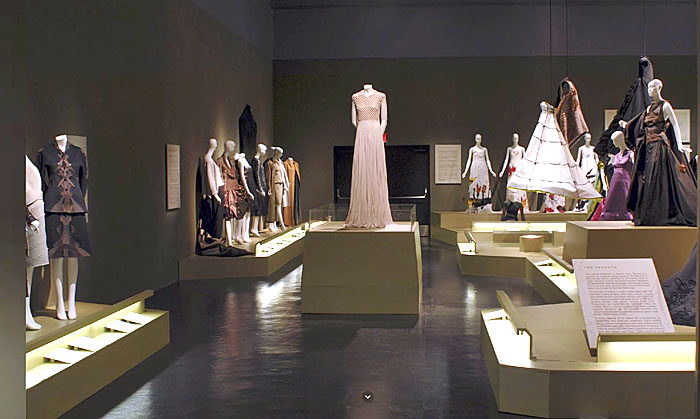
Ralph Rucci, The Art of Weightlessness – photo courtesy Museum at FIT
She delves into the more technical aspect of Rucci’s atelier, describing his design process, from inspiration boards to patterning in his atelier, and even having specialized work done outside the atelier. It’s clearly a mutual admiration society. Ralph notes that what sets Patricia apart from other curators and scholars, and the link that connects all of us, is her “unconscious obsession with the extraordinary in fashion”.
The road to Mears’s career was unplanned. Patricia did her undergrad (art history) and graduate studies (fashion history) at The George Washington University, where I, coincidentally, graduated more than a decade before her. The things that most inspire Patricia are design objects: furniture, lighting, ceramics, etc., as well as architecture. Perhaps this interest comes from her East Asian background.
In Japan, for example, they do not have the same kind of hierarchy as we do in the West, where paintings and fine arts are ranked above all other design disciplines. Perhaps that is why working on the exhibition design with their architect, Kimberly Ackert, was one of the most enjoyable and fulfilling parts of organizing fashion exhibitions.
Mears’s first position in the fashion industry, while still a graduate student at FIT, was as an NEA-sponsored intern at the Brooklyn Museum. She was named Assistant Curator of Costumes and Textiles in 1995. That institution had one of the world’s great costume and textile collections. (It was subsequently transferred to the Metropolitan Museum’s Costume Institute in 2009).
This gave Patricia ready access to fabulous 19th-century garments, including couture by Worth, Doucet, and Pingat, and she was able to study wardrobes belonging to such legendary women of style as Millicent Rogers, who was best known as a client of Schiaparelli, Mainbocher, and Charles James.
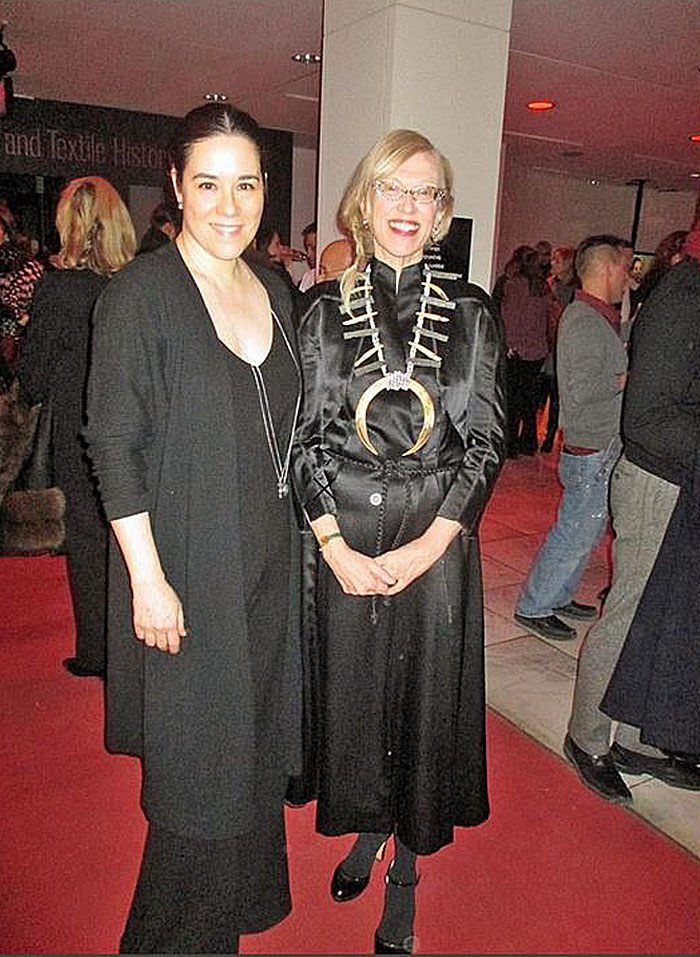
Patricia Mears in vintage Halston and Dr. Valerie Steele in Ralph Rucci, Photo by Marilyn Kirschner
After 12 years at the Brooklyn Museum, Mears worked as a freelance curator before being offered a position by Valerie Steele at The Museum at FIT. She was hired as a research curator in 2005 and became MFIT’s deputy director a year later.
And as they say, the rest is history! Well, fashion history!
